
USD 495.00
Currency
30-Day Money-Back Guarantee
Qty:

Auditing food safety isn't like auditing a typical management system. You're not just checking that procedures exist – you're verifying that HACCP controls are genuinely protecting consumers, that monitoring is happening on the factory floor, and that corrective actions are taken before unsafe product leaves the facility. That takes an auditor who understands both the standard and the realities of food production.
This online Auditor training builds that capability. You'll learn how to interpret ISO 22000:2018 requirements from an auditor's perspective, evaluate HACCP plans, assess prerequisite programs, and document findings that drive genuine food safety improvements. Through a structured curriculum combining theoretical knowledge with practical application, you will develop the competence to audit food safety management systems against ISO 22000:2018 requirements.
The course is delivered entirely online and is self-paced, allowing you to progress through the material according to your own schedule. Upon successful completion, you will receive a certificate documenting your training as an ISO 22000 Auditor.
30-Day Money-Back Guarantee
If the course is not right for you, request a full refund within 30 days, provided you have not completed it.
An effective internal auditor does more than check compliance boxes. They help their organization identify improvement opportunities and strengthen the food safety management system. A competent ISO 22000 auditor must be able to:
This course develops these capabilities through structured lessons, practical examples, and audit resources you can apply immediately in your organization.
The training is organized into eight focused sessions that build your knowledge progressively. Sessions include:
Session 1: Overview of ISO 22000:2018
An introduction to the ISO 22000 standard – its purpose, scope, and position within the food safety landscape. Understand who uses this standard, why certification matters, and the benefits of an effective FSMS.
What you'll learn: The role of ISO 22000 in food safety management and the business case for certification.
Session 2: ISO 22000:2018 Requirements of FSMS
A comprehensive clause-by-clause review of the ISO 22000:2018 standard. You will examine each requirement in depth, understanding what constitutes acceptable evidence of conformity in a food safety context.
What you'll learn: Detailed understanding of ISO 22000 requirements and how to evaluate conformity during an internal audit.
Session 3: ISO 22000 Documented Information
A focused examination of documented information requirements. Learn the practical differences between documents (maintained and updated) and records (retained as evidence). Covers document control, version management, and retention.
What you'll learn: How to audit document control systems and verify that FSMS documentation is properly maintained.
Session 4: ISO 22000:2018 Internal Management System Audit
This session introduces the complete internal audit cycle, from planning through follow-up. Learn audit methodologies, how to prepare for an FSMS audit, and how to conduct audit activities professionally.
What you'll learn: How to plan and conduct internal audits of food safety management systems.
Session 5: ISO 22000:2018 Internal Audit Records
Audit proceedings and findings must be properly documented. This session covers audit preparation documentation, evidence gathering, audit reporting, and completion with follow-up activities.
What you'll learn: How to document audit activities and maintain records that demonstrate compliance.
Session 6: Introduction to HACCP
HACCP (Hazard Analysis and Critical Control Point) is a fundamental component of ISO 22000. This session covers HACCP principles, hazard identification, critical control points, and how auditors evaluate HACCP systems.
What you'll learn: How to audit HACCP systems and verify that hazard controls are effectively implemented.
Session 7: Steps for ISO 22000:2018 Installation and Certification
This session examines the complete implementation pathway, from initial gap analysis through certification audit. Understanding this process helps auditors provide valuable insights during internal audits.
What you'll learn: How organizations implement ISO 22000 and how internal audits support the certification process.
Session 8: Climate Action Changes – New Amendments (2024)
This session covers the latest amendments to ISO 22000 regarding climate action. Understand how climate change considerations are now integrated into the FSMS framework and what auditors need to verify.
What you'll learn: The 2024 climate action amendments and their implications for FSMS audits.
The course provides comprehensive resources that support learning and serve as valuable references:
This course is designed for people who will conduct assigned audit activities and contribute reliable evidence and findings to an internal audit program. It is particularly useful for:
The course is appropriate for those new to auditing as well as experienced professionals seeking to update their knowledge of ISO 22000:2018.
Note: If you need to lead audit teams, plan audit programs, or conduct third-party audits, the ISO 22000 Lead Auditor Training is a better choice.
The training program includes session exams and a comprehensive final examination. The assessments are in multiple-choice format and are designed to verify your understanding of the course material. To pass, you need a score of 60% or higher. If you do not pass on your first attempt, you may retake any exam at no additional charge.
Graduates receive an ISO 22000:2018 Auditor Certificate of Attainment bearing the Exemplar Global logo. It documents successful completion of the training and final examination and provides a pathway to apply for relevant Exemplar Global personnel certification.
The certificate also bears the IACET accreditation mark, and the course awards 1.6 IACET CEUs.
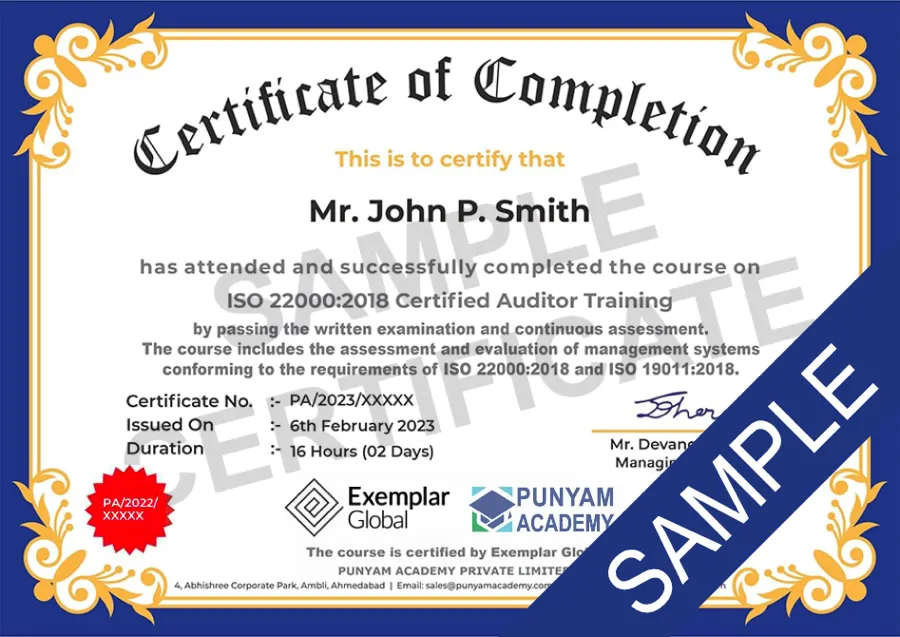
Certificates are issued in digital format upon passing the final examination. You may download, add to LinkedIn, and print your certificate directly from your course dashboard.
Training multiple internal auditors for your ISO 22000 food safety management system? Our platform makes it simple to purchase multiple seats and manage enrollment across your organization.
Whether you’re training one internal auditor or building a team to cover your entire FSMS scope, the manager dashboard gives you oversight of every learner's progress.
Course access, materials, certificate plus manager dashboard for bulk enrollment.

Self-paced learning – fit the 16-hour program into your schedule without disrupting business.

Instructor access and technical support whenever you need assistance.

30-Day Money-Back Guarantee – enroll risk-free.

Instant access after enrollment with up to 3 months to complete.

Learn on any device – Windows, Mac, iOS, or Android.


Dylan Nguyen
May 18, 2025
Clear guidance on audit trails and documenting nonconformities made this stand out. The short quizzes after each ...
Valentina Rossi
August 6, 2025
The course gave me real confidence to audit food safety systems. The case studies on prerequisite programs ...

Built for Food Safety Auditing
Every session is written for FSMS auditors – not adapted from a generic management system template.

Dedicated HACCP Session
Learn how to audit HACCP systems – not just what the standard says, but what evidence to look for and what questions to ask on the factory floor.

400+ Audit Questions
Includes clause-wise and department-wise checklists you can adapt for audits of your own organization.

Professional Credential and Pathway
Earn a Certificate of Attainment bearing the Exemplar Global logo and gain a pathway to relevant Exemplar Global personnel certification.
You have up to three months. During that time, you can complete the training at your own pace and revisit earlier material.
Access ends when you successfully complete the final examination. Extensions are available for a fee if you need more time.
Auditor training prepares you to conduct assigned internal-audit activities as a team member.
Lead Auditor training covers additional competencies required to plan audits, lead audit teams, and manage the entire audit program.
Choose this Auditor course when you are beginning or contributing to an internal audit program.
Yes. The course includes a dedicated session on HACCP (Hazard Analysis and Critical Control Point), which is a fundamental component of ISO 22000:2018. You will understand how HACCP principles integrate with the food safety management system.
Yes. The course includes a dedicated session (Session 8) on the Climate Action Changes amendments (2024) to ISO 22000, ensuring your knowledge is current with the latest standard requirements.
Yes. The 400+ question audit checklist provided with the course is designed to be a practical tool that you can customize and use for internal audits within your organization.
There are no formal prerequisites. Familiarity with food-safety operations is helpful, but the course teaches the ISO 22000 requirements and audit techniques you need.
Your purchase is protected by our 30-Day Money-Back Guarantee. If the course is not right for you, request a full refund within 30 days, provided you have not completed it.
Yes. Select the number of learners on this page and applicable volume discounts are applied automatically. A course manager can enroll the team and monitor progress from one dashboard.
When you purchase multiple seats, designate a course manager during checkout. The manager has up to 12 months to enroll the team. Once enrolled, each learner has up to three months to complete the course, and access ends upon successful completion of the final examination.
The charts below show our approval ratings based on post-course surveys from 2000+ learners. Enroll risk-free with our 30-Day Money-Back Guarantee.









(254)
USD 695.00
Lead complete ISO 22000 FSMS audits. Evaluate hazard analysis, prerequisite programs, operational controls, traceability, emergency response, and performance while directing audit teams. The certificate bears the Exemplar Global logo and supports application for relevant Exemplar Global personnel certification.
(1071)
USD 895.00
Perform assigned ISO 9001 audit activities as an effective internal audit-team member. Exemplar Global TPECS-certified online training with formal exam, unlimited retakes, Certificate of Attainment, and QM and AU Competency Units.
